
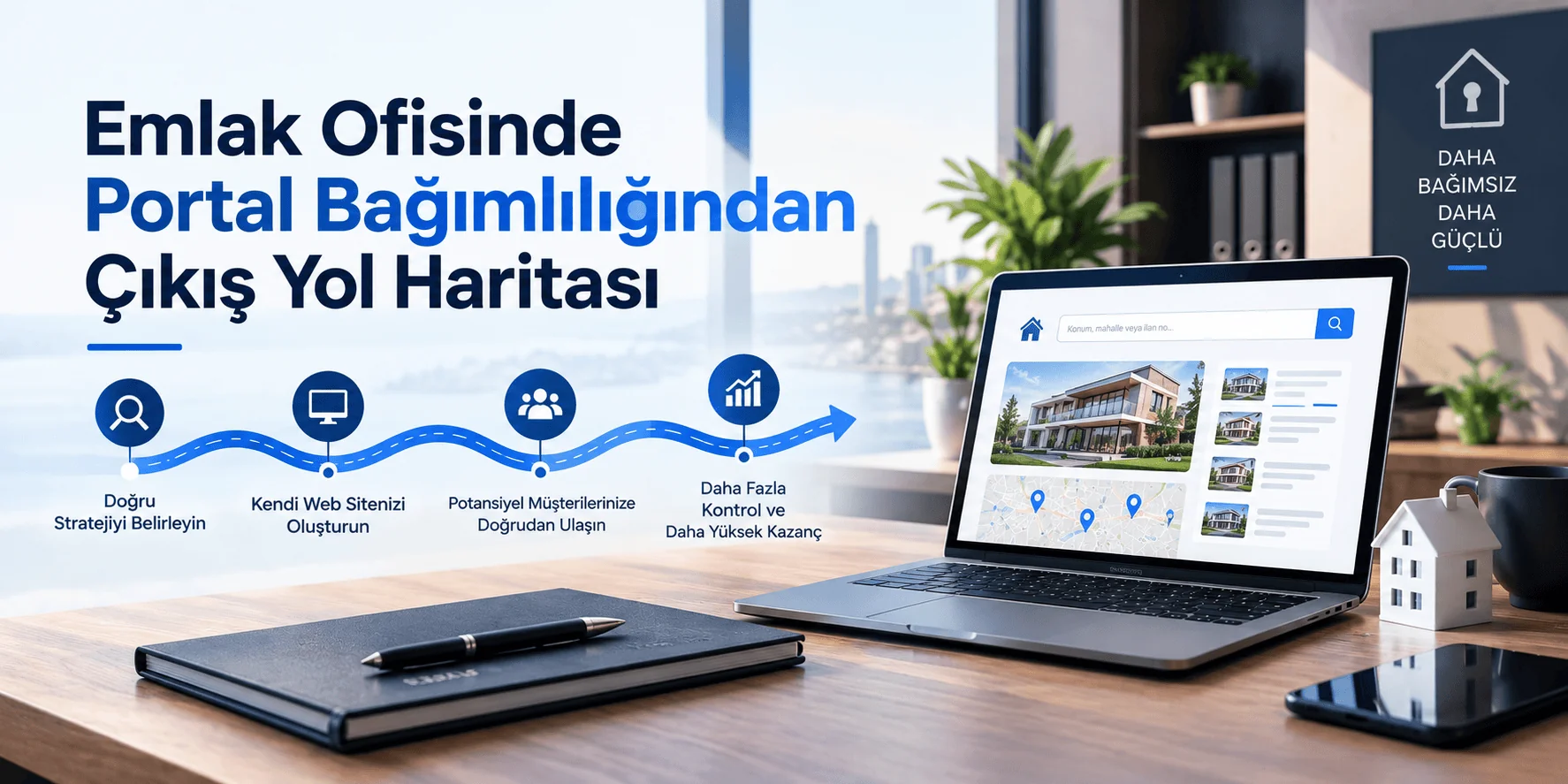
Short answer: the goal is not to leave listing portals, but to stop depending on them. You do that by keeping your portfolio, your demand records and your customer data in your own system, while still using portals as a sales channel. The transition typically runs in four phases over 6–12 months.
Who is this article for?
Why portal dependency is a business risk, not just a cost line
Listing portals are a genuine source of demand in real estate; any strategy that denies this starts out wrong. The problem is not that portals exist, but that they become the agency's only source of demand. At that point four structural risks appear:
- You do not hold pricing power. When package or promotion prices rise, you have no negotiating position; if all demand comes from there, an increase is not a choice but an imposition.
- Customer data does not accumulate with you. The caller is the portal's user. When the same person comes back six months later, the party that knows which listings they viewed before is the portal, not you.
- You are listed next to your competitors. Competition on a portal collapses into price and photography; service quality, expertise and references become invisible.
- When an agent leaves, the portfolio leaves too. If records live on the agent's phone, the office loses both the portfolio and the demand history the day they resign. This is the most expensive loss in the sector.
The goal here is not to abandon portals. The goal is to be able to say: "Portals bring us demand, but the data, the history and the follow-up of that demand live in our system."
Measure your dependency: a five-question test
Answer honestly. Each "yes" is one point:
- Did more than 70% of last month's enquiries come from listing portals?
- Can you see your entire portfolio, with current status, on a single screen? (If the answer is no, count this as a yes.)
- If an agent resigned today, would you be unable to produce the list of buyers they were talking to?
- Have you had cases where several agents were separately working the same property with different clients?
- Do you know the number of enquiries from your own website as a separate figure? (If not, count this as a yes.)
| 0–1 | Healthy | Deepen your existing system on the reporting side. | 2–3 | Fragile | Move portfolio and demand records into one place first. | 4–5 | High risk | Data ownership is urgent; start Phase 0 this month. |
The seven core modules of your own system
When agencies think about software, they usually picture "a site that publishes listings". The real value, however, is not in the shop window but in the record-keeping discipline behind it. A working system has seven core modules:
| 1. Property records | All property details, title status, photos, who holds the keys and price history sit on one card. "Is this flat still for sale?" stops being a round of phone calls. | 2. Demand records (buyers/tenants) | The caller's budget, preferred district, room count and urgency are captured. Demand moves out of an agent's memory and becomes an asset of the office. | 3. Automatic matching | When a new property is entered, waiting enquiries that fit the criteria are listed instantly. This is the module with the fastest payback in the sector. | 4. Agent and commission management | Ownership of each property and enquiry, plus split rates on shared deals, are defined in the system. The "this client was mine" argument ends. | 5. Listing syndication | A property is entered once and feeds your website and — on channels that support it — external outlets. Writing the same listing three times disappears. | 6. Document and process tracking | Viewing forms, contracts, valuations and title appointments are tracked step by step. Which file is waiting at which stage becomes visible. | 7. Reporting | Enquiries by channel, agent conversion rate, average time to sale and portfolio ageing. This is where the advertising budget is managed from. |
One caveat: you do not need all of these at once. In a three-agent office, modules 1 to 4 cover the whole first six months. Modules 5, 6 and 7 are the second wave.
The exit roadmap: four phases
Phase 0 — Data ownership (0–30 days)
One goal: collect the scattered portfolio in one place. You are still not buying software. Tasks: gather every agent's property and active enquiry list into a shared template, remove duplicates, and assign an owner to each property. Skip this and every later phase starts on bad data.
Phase 1 — Central property and demand records (1–3 months)
The property and demand modules go live and agents get accounts. The critical rule: no listing goes to a portal before it exists in the system. Without enforcement, the system is abandoned within weeks. At the end of this phase you get your first meaningful report: how many properties do you actually hold, and how many are genuinely sellable?
Phase 2 — Opening your own demand channel (3–6 months)
A website fed by the portfolio goes live: filterable listings, map, detail pages and an enquiry form routed directly to the right agent. The point is not to compete with portals on volume, but to capture the visitor a second time on your own ground and to receive people searching for your brand. Channel-level measurement starts here — "how many enquiries this month came from portals, and how many from our own site?"
Phase 3 — Automation and integration (6–12 months)
Match notifications, document tracking, e-signature or accounting links, and any external API integrations arrive in this phase. By now the portal is no longer a necessity but a measurable advertising line: once you can calculate the acquisition cost of the demand it brings, you decide on the budget with data rather than instinct.
Off-the-shelf CRM or custom software?
There is no single right answer; office size and process divergence decide it:
| Upfront cost | Low, monthly subscription | Higher, one-off development | Three-year total cost | Grows quickly with agent count | Fixed, plus a maintenance line | Your own commission and split rules | You must fit the standard template | Written around the office's real rules | Data ownership | On the provider's servers | In your own database | Time to go live | Days | Weeks | Franchise / multi-branch structure | Usually needs an extra package | Designed in from the start |
The practical threshold: for offices with one to four agents, starting with an off-the-shelf CRM is usually the smarter move. Once you pass eight to ten agents, or when commission splits and branch structure no longer fit a standard template, custom software becomes economically stronger. You can see how we structure our own industry products on the software page.
Six common mistakes
The Eskişehir context: student rentals and project sales do not fit one list
The property market in Eskişehir runs at two different rhythms. The rental market fed by the universities spikes at the end of summer: decisions are fast and volumes are high, and what wins is having the demand pool ready — a list of waiting tenants already in hand in August. Residential sales and new-build projects in Odunpazarı and Tepebaşı are the opposite: a process spread over months, heavy on paperwork and repeat meetings, where what wins is file tracking and disciplined follow-up.
Offices that try to manage both flows in a single flat list end up buried under rental enquiries in season and neglect their sales files. When the system is set up, the enquiry type (rental / sale / project) should be a distinct field from day one, with notifications and reporting built on that split. It is the most common gap we see locally.
Frequently asked questions
If I build my own system, should I leave listing portals entirely?
No, and we would not recommend it. The right setup is not leaving portals but ending dependency on them. A portal is an acquisition channel; your system is the permanent record of that customer. The aim is to set the portal budget by acquisition cost rather than by instinct.
Can my properties be pushed to portals automatically?
That depends entirely on the integration each portal offers at the time and on your membership type. Some channels provide a data transfer interface for corporate members; others do not, or change their terms. So the safe assumption when building is this: your database is the single source of truth, and syndication to external channels is a convenience added where possible, not a prerequisite.
Is this investment premature for a small three-agent office?
Not if the module selection is right. Even in a small office, property and demand records plus matching save time from the first month. What is premature is installing a seven-module system in a three-person office.
What if agents resist entering data?
Resistance almost always comes from the perception of extra work. Two practices resolve it: simplify the record until it takes 60 seconds, and tie commission eligibility to the record in the system. If an unrecorded property earns no commission, discipline settles by itself.
Can my existing spreadsheets be migrated?
Yes — bulk import is standard work when the column structure is consistent. The real difficulty is not technical but data hygiene: the same property on several rows, missing address details, prices long out of date. That is exactly why Phase 0 should not be skipped.
How soon do I see a return?
The first measurable gain usually comes from matching: when a new property fits a waiting enquiry, first contact happens within hours. The effect of channel-level reporting on the advertising budget becomes visible in the second quarter, once enough data has accumulated.
Summary and first step
Portal dependency looks like a marketing problem but is really a data ownership problem. If properties, enquiries and conversation history sit in the agency's database, the portal is just one channel. If they do not, the agency is paying every month to grow the portal's customer base.
The first step is not buying software: this week, collect every agent's property and active enquiry list into a single template. Once you see that table, which module you need first becomes obvious on its own.
If you are planning a portfolio management system built around your office's actual processes, or you want to establish which phase your current setup is in, send us your agent count and portfolio size and we will map out which modules to start with and how to stage the transition.