Formerly known simply as E-A-T, this concept recently underwent an evolution with the addition of an extra "E" (Experience). But what do these letters actually stand for, and how do they impact your website's ranking?
In this guide, we will dive deep into the pillars of Experience, Expertise, Authoritativeness, and Trustworthiness, and you will learn exactly how to optimize your site to meet these critical criteria.
What is E-E-A-T?
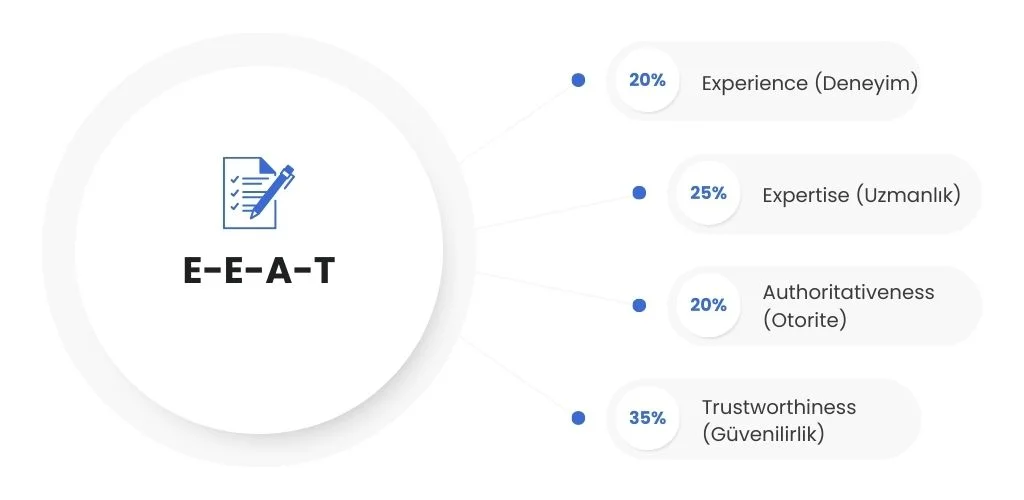
E-E-A-T stands for Experience, Expertise, Authoritativeness, and Trustworthiness. It is a set of criteria Google uses to evaluate the quality of content and the credibility of the website providing it.
Google uses its complex algorithms to identify "high-quality content." E-E-A-T is not a direct technical ranking factor (like page speed), but rather a vital quality signal that tells Google’s algorithms what to aim for.
Let's break down these four pillars one by one.
1. Experience
This is the newest addition to the equation, but in the era of AI-generated content, it might just be the most critical. Google is now asking: "Does the person writing this content have first-hand experience with the topic?"
For example, if you are writing an iPhone 15 review:
- Listing the technical specifications constitutes "Expertise."
- However, describing how the phone feels in your hand, how the camera performs in low light, or whether it overheats during gaming constitutes "Experience."
Users are no longer looking just for theoretical knowledge; they want authentic, lived experience.
2. Expertise
Expertise refers to the knowledge and skill level of the content creator regarding the specific subject matter.
- Who is writing? Does the author have education or credentials in this field?
- Depth of Knowledge: Is the content superficial, or does it cover the topic in comprehensive detail?
Especially in topics related to health, law, or finance (YMYL - Your Money Your Life), having content produced by degreed or accredited experts is a massive plus for Google. However, for a hobby site (e.g., knitting or photography), a formal diploma isn't required; expertise here is measured by the depth of practical knowledge accumulated over years.
3. Authoritativeness
Authoritativeness represents the reputation of your website and your author within the industry.
- Do other authorities cite you as a reference?
- Do other experts in the sector mention your brand?
- Are you receiving backlinks from trustworthy sources like Wikipedia or major news outlets?
If your site is known as the "go-to source" for a specific topic, your authoritativeness is high.
4. Trustworthiness
At the very center of the E-E-A-T concept lies Trustworthiness. The other three factors (Experience, Expertise, Authoritativeness) exist primarily to build this trust.
Trustworthiness encompasses:
- Technical security of the site (Use of SSL/HTTPS).
- Transparency (Who is the author? Who owns the site? Is contact info clear?).
- Accuracy (Is the information backed by verifiable sources?).
The Relationship Between YMYL Sites and E-E-A-T
While E-E-A-T is important for every website, for some, it is absolutely non-negotiable. Google categorizes these sites as YMYL (Your Money Your Life).
If your website contains information that could impact a user's:
- Health,
- Financial stability,
- Safety,
- Legal rights/status,
Google's quality filter becomes much stricter. For instance, giving incorrect advice to a user searching for "how to cure a severe headache" carries life-threatening risks. Therefore, for YMYL sites, Google expects the author to be a medical professional or the content to be heavily cited with high-authority sources.
How to Improve Your Site’s E-E-A-T Score?
Aligning your SEO strategy with E-E-A-T doesn't just improve your Google rankings; it increases your overall brand value. Here is a step-by-step guide on what you need to do:
Create Comprehensive "About Us" Pages
Users and Google bots want to know who is behind the curtain. On your "About Us" page, clearly state your company's history, mission, awards, and physical address. Anonymity is the enemy of E-E-A-T.
Optimize Author Biographies
It is no longer enough to simply have "Admin" or "Editor" listed under your blog posts. Every piece of content should display who the author is, their title, their experience, and links to their social media profiles (especially LinkedIn).
- Example: "Dr. Jane Smith, Cardiologist, 15 years of clinical experience."
Update Content Regularly
Old and outdated information damages credibility. Regularly review and update your articles, especially those containing tax rates, medical guidelines, or tech reviews. Adding a "Last Updated" date at the top of the content signals to both users and Google that you are providing fresh information.
Use External Resources and Citations
Prove your claims. If you are presenting a statistic, back it up by linking to a reliable source (university research, government agency, etc.). This significantly boosts the "Expertise" and "Trustworthiness" levels of your content.
Manage Brand Reputation
Off-site signals are crucial for E-E-A-T as well. Monitor reviews about your brand on platforms like Trustpilot, Google Maps, or industry-specific review sites. While positive reviews increase your authority, responding professionally to complaints reinforces your trustworthiness.
E-E-A-T Criteria: Good vs. Bad Examples
The table below will help you clearly understand what constitutes high versus low E-E-A-T signals in Google's eyes.
| Criteria | High E-E-A-T Signal (Good Example) | Low E-E-A-T Signal (Bad Example) |
|---|---|---|
| Author Info | Written by a subject matter expert, includes a detailed bio and social proof. | Written by "Admin" or "Site User," with absolutely no information about the author. |
| Content Quality | Original, contains in-depth analysis, based on experience, and cites sources. | Copied/spun from other sites, superficial, full of typos, and lacks sources. |
| Contact Info | Clear physical address, phone number, email, and accessible support channels. | No contact page exists, or only a broken generic contact form is provided. |
| YMYL Compliance | A medical article written by or reviewed by a qualified doctor. | A blog post giving specific medical advice written by a hobbyist with no credentials. |
| Reputation | References from leading industry sites and positive user reviews. | Numerous unresolved complaints or allegations of "scams" found online. |
Summary: The Future of SEO is Built on Trust
Google E-E-A-T is not a simple SEO setting you can toggle on overnight and forget. It is the process of building your brand's stance and reputation in the digital world.
In an age where AI tools can generate thousands of words in seconds, the human touch (Experience) and genuine expertise have become more valuable than ever. Google wants to serve its users information that is useful, reliable, and experienced—not "spam content."
When optimizing your website, ask yourself this question: "Would a user feel safe entering their credit card information or trusting their child's health to this site?" If your answer is "Yes," then you are on the right track with E-E-A-T.
Remember: SEO might be a technical job, but E-E-A-T is entirely human-centric. Build trust with humans, and the algorithms will follow.